

The question isn’t only whether AI changes your job. It’s whether anyone can prove the value you create when the rules change.
Organizations have spent decades measuring performance. What most still struggle to measure is contribution: the difference a person actually makes to the outcomes that matter. Traditional systems tend to emphasize hours, outputs, titles, and other things that are easier to count.
AI didn’t create that problem. It industrialized it. As AI scales decision-making, flawed organizational metrics can also be amplified at machine speed and enterprise scale.
The people most exposed may not be the ones whose work is easiest to automate. They may be those whose contribution was never visible in the first place — the judgment that prevented a crisis, the relationship that saved an account, the quiet mentoring that reduced defect rates. Much of that contribution rarely appears on conventional dashboards, making it easier to overlook as AI reshapes work.
Ask yourself honestly: How much of what you contribute this quarter will your organization actually be able to see?
Don’t Let AI Eat You Alive is a practical guide for the people being scored by systems they didn’t design — employees navigating promotion opacity, leaders rebuilding business models, and students choosing what to study next.
It makes an argument that runs against most of what’s being written about AI and work: the winners won’t simply be the people who learn the most tools. They’ll be the people and organizations that can demonstrate contribution clearly, with evidence, and before someone else defines their value for them.
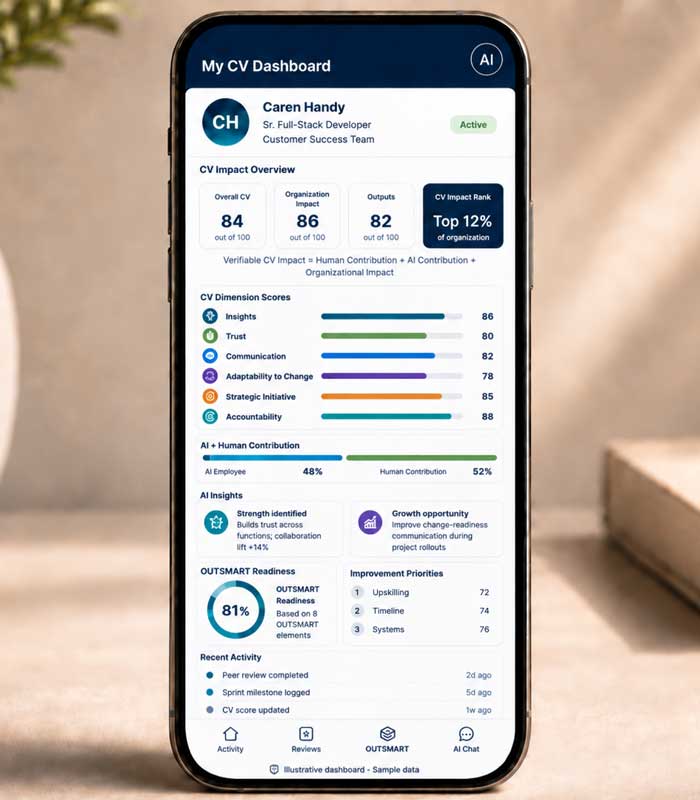
Conceptual OUTSMART + Contributive Value dashboard. Illustrative interface; final features and scoring architecture may vary.
AI is exposing a longstanding failure to recognize and measure human contribution. OUTSMART helps individuals prepare for that new reality, while Contributive Value gives organizations a better way to recognize what people actually contribute.

Understand where AI creates risk and learn how to make your contribution visible.

Distinguish work that can be automated from human contribution worth protecting and amplifying.

Build a more transparent system for recognizing contribution beyond traditional output metrics.
Eight elements individuals can use to understand, strengthen, and demonstrate the value they bring as AI reshapes work.
Six dimension measurement system that makes individual and team contribution visible, connects it to organizational outcomes, and ultimately to economic value.
Treat it as a complete system — skip one and the diagnosis fails.
Clearly positioning your direction within the changing AI landscape.
Actively acquiring new skills needed for AI-driven career growth.
Establishing concrete deadlines and milestones for your actions.
Understanding organizational and technological ecosystems.
Proactively nurturing your own professional resilience.
Gaining access to key information and influential conversations.
Securing essential resources to support effective adaptation.
Collaborating effectively with teams, influencers, and networks.
AI can only optimize what organizations choose to measure. CV changes what gets measured:
Seeing what matters in an organization and turning that understanding into productive action.
A currency every organization runs on and almost none measure.
Clarity, usefulness, timing, and the ability to bridge viewpoints that don’t naturally meet.
The willingness and capacity to move through organizational change, rather than absorb it.
Acting on what matters and solving meaningful problems before being asked to.
Owning your actions and outcomes, including the ones that went wrong.
The CV Dashboard is where the six dimensions will become visible. The dashboard connects contribution to economic value — for the individual, the team, and the enterprise.
The book publishes in 2027. Join the list for release news, preorder access, and early excerpts from the CV framework as they’re released.
Across three decades in Fortune 500 companies, high-tech startups, and his own ventures, Rod has built systems that drove measurable growth. He grew an ERP services channel with Dell from zero to $60 million in three and a half years and designed Oracle/PeopleSoft’s first ERP go-to-market partner plan, which ultimately accounted for more than 62% of software revenues and tripled software sales across the Midwest. He led a national CRM implementation reaching 3,800 sales representatives that hit 90% adoption inside its first year.
That work taught him something the industry still hasn’t absorbed:
The Contributive Value framework is his answer to that problem.


